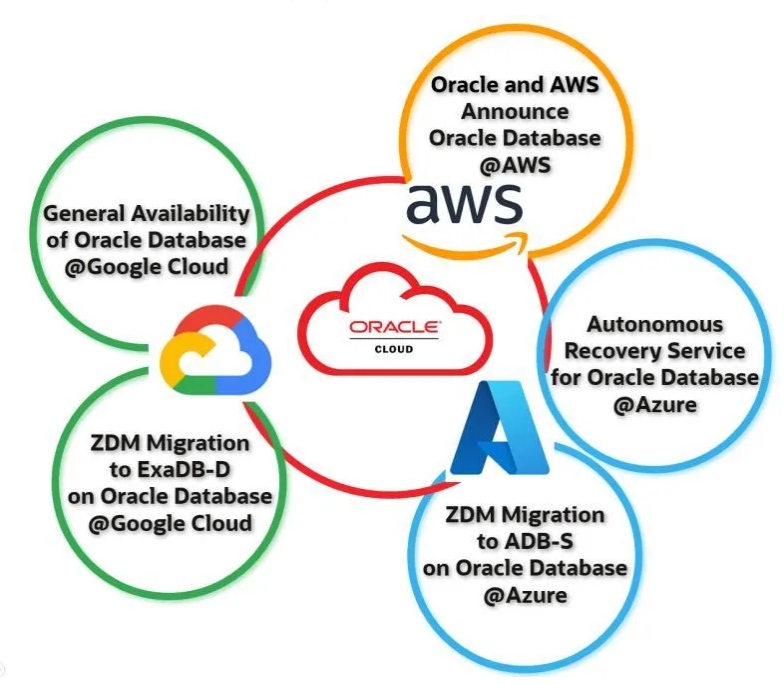
If you’re facing challenges managing workloads across different clouds and want to integrate them seamlessly, this read is for you. Recently, I completed a course on Oracle’s multicloud capabilities and had the chance to dive deeper into how Oracle integrates with major cloud providers like Google Cloud, AWS, and Azure. I wanted to share my notes with you so you can get a concise summary of these concepts in just a short read. Let’s break it down and explore how Oracle’s multicloud capabilities can help you modernize, migrate, and maximize your cloud investments.

Here’s the key point: Oracle is the only platform that truly enables multicloud. While other cloud providers offer integrations or partnerships, none offer the level of seamless, enterprise-grade functionality Oracle does across AWS, Google Cloud, and Azure.
What is multicloud and why does it matter?
A multicloud strategy means using services from multiple cloud providers, like OCI, AWS, Azure, and Google Cloud, to meet specific business needs. It offers flexibility, cost optimization, and the ability to take advantage of each cloud provider’s unique strengths. However, the challenge lies in ensuring seamless connectivity, consistent performance, and simplified management across these clouds.
Oracle’s multicloud solutions address these challenges with innovative approaches, enabling businesses to:
- Use the best services from multiple cloud providers.
- Achieve high performance for mission-critical workloads.
- Minimize data transfer costs and latency.
- Simplify operations and management.
How does Oracle differentiate in the multicloud space?
Oracle stands apart as the only provider offering true multicloud capabilities, making it possible to run mission-critical applications across multiple clouds without compromise. Here’s how Oracle differentiates:
- Purpose-built database solutions: Oracle’s Autonomous Database and Exadata offer unmatched performance and reliability for mission-critical workloads.
- Low-latency connectivity: Unique direct private network links, such as with Azure and Google Cloud, minimize latency and ensure seamless data flow.
- Cost-efficient integrations: Zero ingress/egress fees within certain regions and reduced network transfer costs make Oracle’s solutions highly economical.
- Comprehensive support: Oracle works closely with hyperscaler partners to provide integrated management tools and guided implementation, simplifying multicloud adoption.
- Hybrid-friendly architecture: Oracle’s multicloud design supports hybrid workloads, enabling businesses to run applications across on-premises and cloud environments without disruptions.
No other platform offers this level of integration across AWS, Google Cloud, and Azure. Oracle has created a multicloud ecosystem where enterprises don’t have to choose one cloud — they can have it all.
Oracle’s multicloud offerings with hyperscalers
1. Oracle Database@Google Cloud
With Oracle Database@Google Cloud, you can run Oracle’s high-performance databases in Google Cloud environments while taking advantage of Google’s services. Here’s why this matters:
- No ingress or egress fees in the same region: Traffic between the Google Virtual Private Cloud (VPC) and Oracle’s Virtual Cloud Network (VCN) in the same region incurs zero additional costs. This ensures predictable billing and cost savings.
- Seamless connectivity: A direct private network connection allows smooth data transfer between OCI and Google Cloud services without compromising performance.
- Key use case: Businesses running AI or machine learning models on Google Cloud can seamlessly integrate Oracle’s Autonomous Database for robust data management.
- Unique benefit: The integration accelerates application migrations and modernization by combining Oracle’s robust database capabilities with Google Cloud’s AI/ML strengths.
2. Oracle Database@AWS
Oracle’s collaboration with AWS brings the power of Oracle databases into AWS availability zones. Here are the highlights:
- OCI in AWS regions: Oracle Database@AWS operates on dedicated infrastructure within AWS data centers, combining the scalability of AWS with the performance of Oracle’s Exadata.
- Simplified provisioning: Setting up Oracle Database@AWS is straightforward, requiring just four steps:
Create the Oracle Database (ODB) network.
Provision Exadata infrastructure.
Set up an Exadata VM cluster.
Deploy Oracle Database.
- Key use case: Perfect for enterprises running applications in AWS but needing high-performance databases with Oracle’s reliability.
- Unique benefit: Oracle’s low-latency network link makes it ideal for intelligent applications that demand quick database access.
3. Oracle Database@Azure
Microsoft and Oracle’s partnership unlocks a multicloud powerhouse with Oracle Database@Azure:
- Direct network link: A private, high-speed interconnect ensures low-latency connectivity between Azure and OCI resources.
- Hybrid use cases: Oracle databases can integrate seamlessly with Azure’s analytics tools, enabling hybrid cloud strategies.
- Key use case: Ideal for businesses running Azure-based applications, like Microsoft Dynamics, that require the reliability and scalability of Oracle’s database solutions.
- Unique benefit: Accelerates mission-critical applications with Oracle Database’s enterprise-grade capabilities, paired with Azure’s comprehensive cloud ecosystem.
Why choose Oracle for multicloud?
1. Cost efficiency
- Oracle’s partnerships reduce data transfer fees for multicloud setups, ensuring predictable costs.
- Autonomous capabilities in OCI minimize database administration overhead.
2. Performance and scalability
- Oracle’s Exadata and Autonomous Database deliver unmatched performance, making it ideal for mission-critical workloads.
- High availability and disaster recovery are baked into Oracle’s multicloud architecture.
3. Flexibility
- Choose the best tools from different providers while keeping your data centralized and secure with Oracle’s multicloud solutions.
4. Simplified operations
- With OCI’s integrated management tools, you can oversee multicloud environments from a single interface.
- Automated updates, security patches, and scaling capabilities streamline cloud operations.
Real-world use cases for Oracle’s multicloud
1. AI-powered applications
A healthcare company runs machine learning models on Google Cloud but uses Oracle Autonomous Database for secure and scalable data storage. Oracle’s integration ensures low-latency data transfer for real-time model training and inference.
2. Hybrid cloud analytics
A retail business uses Microsoft Power BI in Azure for analytics while leveraging Oracle Exadata to process and store transactional data. The OCI-Azure Interconnect provides seamless data flow between the two environments.
3. Modernizing legacy applications
An enterprise with on-prem Oracle databases migrates to AWS while maintaining database performance and reliability through Oracle Database@AWS. This allows them to modernize their apps without rearchitecting the database layer.
Real-world use cases for Oracle’s multicloud
1. AI-powered applications
A healthcare company runs machine learning models on Google Cloud but uses Oracle Autonomous Database for secure and scalable data storage. Oracle’s integration ensures low-latency data transfer for real-time model training and inference.
2. Hybrid cloud analytics
A retail business uses Microsoft Power BI in Azure for analytics while leveraging Oracle Exadata to process and store transactional data. The OCI-Azure Interconnect provides seamless data flow between the two environments.
3. Modernizing legacy applications
An enterprise with on-prem Oracle databases migrates to AWS while maintaining database performance and reliability through Oracle Database@AWS. This allows them to modernize their apps without rearchitecting the database layer.
Getting started with Oracle’s multicloud
1. Identify your workloads
Determine which workloads benefit from multicloud strategies — e.g., databases, analytics, or AI.
2. Select the right integration
Choose the hyperscaler that complements your existing environment. For example:
- Use Azure if you rely on Microsoft services.
- Use Google Cloud for AI-heavy applications.
- Use AWS for scalable application hosting.
3. Leverage Oracle’s expertise
Oracle’s multicloud solutions include dedicated support and guidance to help you architect the ideal environment.
Conclusion
Oracle’s multicloud capabilities make it easier than ever to combine the best services from multiple cloud providers. Whether you’re running AI models, modernizing legacy apps, or optimizing analytics, Oracle ensures seamless connectivity, cost efficiency, and unparalleled performance.
Unlike other platforms, Oracle is the only choice for true multicloud, providing unmatched integration and functionality across AWS, Google Cloud, and Azure. Why settle for one cloud when you can have the best of all worlds? With Oracle leading the charge, multicloud isn’t just a strategy — it’s your competitive advantage.
You can contact me, as always, on my LinkedIn 🙂